Preparing for PhD Virtual Interviews
If you received a PhD interview, congratulations!! This is a major accomplishment, and you should be proud of yourself. Take a moment to celebrate how far you’ve come.
This article is written for first-generation students who are navigating PhD virtual interviews, often without having someone in their immediate circle who has gone through this process before. Here is what you will learn:
What are pre-interviews?
5 key tips to prepare for your PhD virtual interview
How to thoughtfully follow up with thank-you messages
How to navigate rejection if it happens
This guidance is based on my personal experiences interviewing virtually for Clinical/Counseling PhD programs as a first-generation Latina, along with strategies and feedback that helped me feel prepared and confident.
What are Pre-Interviews?
Many PhD programs include one-on-one faculty pre-interview meetings, which are an important step in determining whether you move on to the next stage of the interview process. Pre-interviews are usually conducted by your potential mentor to talk about your experiences, determine fit with the lab, and/or answer any questions you may have about the program.
When you receive a pre-interview invitation via email, ensure to confirm your availability promptly and express gratitude for the opportunity. Here is an email template you can use to respond to a pre-interview invitation:
-
Description Hello [Dr. Professor Last Name],
Thank you for reaching out in regard to my application for [Include University Name and Program] PhD program.
I am excited for this opportunity and am looking forward to scheduling a pre-interview. A pre-interview this week works great, I am available [include date/time] and [include date/time]. Please let me know if this works for you, I’m looking forward to meeting you soon!
Kindly,
[Your Name]
Pre-interview meetings are often short, around 30 minutes, where you are asked 4-5 questions and will have the opportunity to ask 1-2 questions to your potential mentor.
Resources:
After your pre-interview, send a thank you email. Here is a template you can use:
-
Hello [Dr. Professor Last Name],
Thank you again for taking the time to speak with me during the pre-interview. I truly appreciated the opportunity to learn more about [insert 1-2 points discussed during your conversation].
Our conversation strengthened my excitement about the possibility of contributing to your lab and growing as a researcher and clinician under your guidance.
Please don’t hesitate to reach out if there is anything further needed from me, I look forward to hearing back in regard to my application status soon.
Best,
[Your Name]
After your pre-interview, you will be contacted with a decision about whether you will move on to the official interview stage (with the university department). If you are invited to the official interview, congratulations! Below are five tips to help you prepare for your virtual PhD interview.
If you are not invited to the official interview stage, you can skip to the following section: “How to Navigate Rejection - If It Happens.”
5 Tips to Prepare for Virtual PhD Interviews
If you’ve moved forward to the formal interview stage, congratulations! This section will help you feel prepared and confident by walking you through these 5 key tips:
Technology Considerations
Physical space
Dressing professionally
Referencing Interview Notes
Managing Zoom Fatigue
1. Technology Considerations
For virtual interviews, consider a few technological factors to ensure a smooth interview experience. Check that your internet connection, camera, and audio are working properly ahead of time.
I prepared backup options, including having Zoom installed on my phone and access to hotspot in case of technical difficulties on my computer. A hotspot may not be necessary if you have a strong internet connection, during interview season I personally experienced Wi-Fi issues, so I kept a hotspot ready as a backup.
2. Physical Space
Be mindful of your physical space and how it makes you feel. Good lighting through open windows may be helpful, having a clean room, and blurring your background on Zoom to help minimize distractions during the interview.
As a personal preference, I lit a candle, as the aroma helped me relax and provide a soft, comforting light.
3. Dressing Professionally
Dress in formal clothing as if you were attending the interview in person, including dress pants (even if they won’t be seen). This helps put you in an interview mindset vs. only wearing a dress shirt and sweats/shorts.
Being fully dressed in interview clothes personally helped me feel prepared.
4. Referencing Interview Notes
When preparing notes, use bullet points rather than a full script. Practice saying your bullet points out loud. When I met with my mentor for a mock PhD interview, one piece of feedback I received was to be mindful of when you are reading off your notes.
Notes should guide your responses, not be read word-for-word. If this is challenging, practice saying your responses out loud with your notes next to you, while only glancing at them as needed. For example:
Instead of writing:
I have always been passionate about mentorship because I enjoy helping others grow and learn from my experiences
Use bullet points:
Passionate about mentorship
Enjoy helping others grow
Share my personal experiences
Another tip I received from my mentor was to print out my notes and keep them in front of me as a reference. Having notes nearby often provides a sense of security and reassurance that you are prepared, and they can be helpful if you momentarily forget a point.
Ultimately, interviews should feel conversational, as the interviewer is trying to get to know you. Don’t be afraid to show your personality while sharing your experiences, your interest in the program, and your motivation for pursuing a PhD.
5. Managing Zoom Fatigue
Managing zoom fatigue is an important aspect of virtual interviews to consider. These interviews are often scheduled for long stretches of time. For example, you might have meetings from 9:00am to 3:00pm with only short breaks in between, so it’s helpful to plan ahead. Below are two example interview schedules from Clinical Psychology PhD programs I interviewed with.
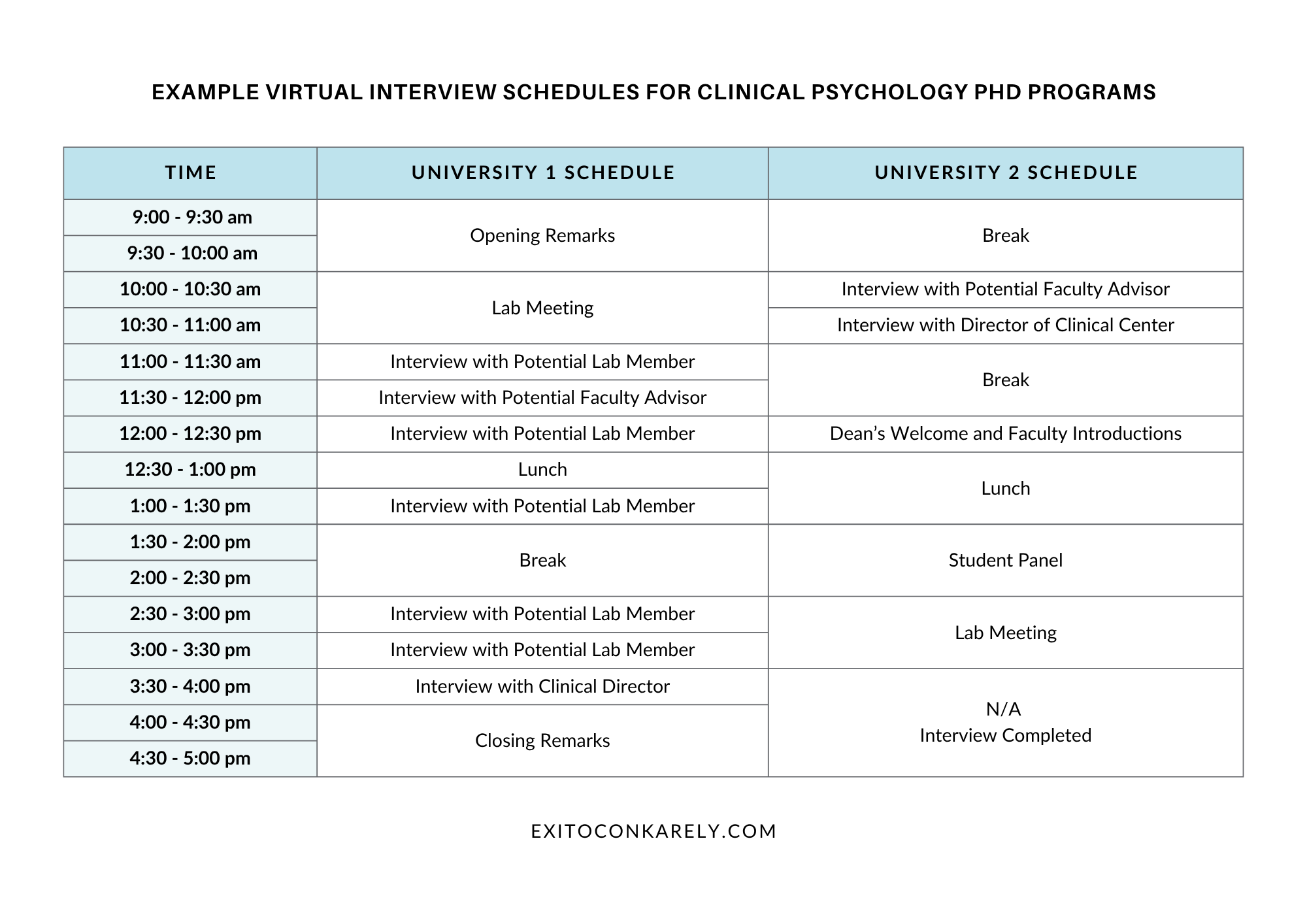
*Depending on the size of the lab, you may or may not have individual interviews with each lab member. In my interview experience, I came across both: interviewing one-on-one with lab members and interviewing with several lab members together in a group setting.
When you do have breaks, take a few minutes to step away from your computer, stretch, eat lunch, get water, or go for a short walk to reset your energy. After the interview day is over, remind yourself that you did the best you could and take a moment to feel proud of getting through the interview!
Lastly, send thank-you emails to everyone you interviewed with. Make each message personalized. If someone shared something interesting with you during your conversation, mention it in your email to show that you were engaged and appreciated the conversation.
-
Subject: Thank you for the interview opportunity
Hello [Dr. Professor Last Name],
I hope you are doing well. Thank you for the opportunity to interview with [University Name] [Name of Program] PhD program this week. I truly appreciated our conversation and the chance to learn more about [insert 2-3 points you learned during your conversation].
Our discussion further reinforced my excitement about the program and my strong interest in the research being conducted. I am grateful for your insights and for the thoughtful questions you shared during the interview. Thank you again for your time and consideration, I look forward to hearing back soon with admission decisions. I hope you have a great rest of your day.
Best,
[Your Name]
-
Subject: Thank you for sharing your experiences
Hello [lab members name],
Thank you so much for taking the time to share your experiences in the [Lab Name] and in the [Program Name] PhD program at [University Name].
I appreciated your openness and the chance to hear about [Include 1-2 points you learned during your conversation]. Your insights were incredibly helpful and gave me a clear idea of what it's like to be a graduate student in the program. I am excited about the potential opportunity to join the lab.
Thank you again for your time answering my questions, I hope you have a great rest of your day.
Best,
[Your Name]
How to Navigate Rejection- If it Happens
Rejection can be hard, especially after you’ve put time and care into preparing. If you aren’t moved forward after a pre-interview or selected into your program after the official interview, try to not take it personally. PhD programs are highly competitive and many decisions come down to factors that are outside of your control, not a reflection of your potential or worth.
I had this experience myself, with both a pre-interview rejection and an official interview, and I too felt disappointed when I opened the rejection email. I reminded myself that I had genuinely prepared and showed up as best as I could. A few other things that helped me were:
Reflecting on what went well so I could carry those strengths into future interviews
Keeping the bigger picture in mind- one decision did not define my potential or journey to a PhD
Shared my experience with loved ones for support and encouragement
Allowed myself to express my emotions without judgment
As a professional courtesy, reply to the rejection email with a thank you for the opportunity. You can use the email template below:
-
Hello [Dr. Professor Last Name],
Thank you so much for taking the time to meet with me and for following up about the pre-interview. I truly appreciated the opportunity to speak with you about [include 1-2 points discussed during your conversation].
While I am disappointed not to move forward as a candidate, I was very grateful to be considered as an applicant. Thank you again for your time and consideration, I wish you and your students continued success and I hope our paths may cross again in the future.
Warm regards,
[Your name]
Buena Suerte! I’m Rooting For You!
And there you have it, in this article we covered:
What are pre-interviews?
5 key tips to prepare for your PhD virtual interview
How to thoughtfully follow up with thank-you messages
How to navigate rejection if it happens
One final piece of advice: celebrate your wins. You’ve already come so far, and that matters. Y como me dice mi mama, échale ganas. You belong in these spaces.